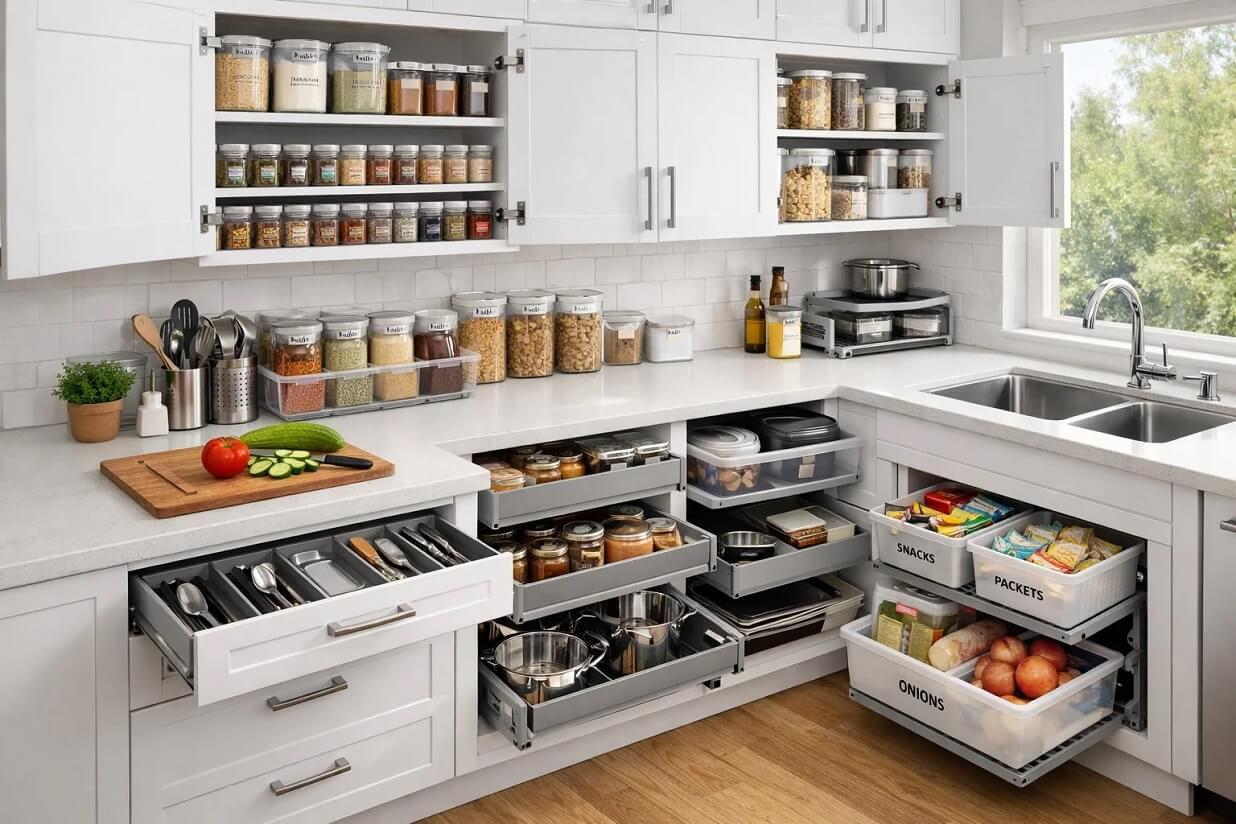
There’s a quiet kind of chaos that lives behind most pantry doors. You open them with the best of intentions, and somehow, a half-empty bag of lentils from God knows when tumbles onto your foot while a mystery can rolls to the very back of the shelf, never to be seen again.
Sound familiar? You’re not alone. According to the UN Environment Programme, households are responsible for discarding roughly 11% of all food available at the consumption stage globally. And a big part of that comes down to one simple, fixable problem: we can’t see what we have.
Well-organized pantry storage, therefore, is about aesthetics, function, and saving money. You don’t need to buy a third box of pasta because the first two are hiding behind a bag of chips.
When your pantry works for you, the whole kitchen feels calmer. And the good news? You don’t need a renovation budget or a walk-in space the size of a small bedroom to get there. You only need a plan and a little creativity.
So let’s talk about how to make that happen.
Pantry Storage Ideas That Look as Good as They Function
Start by Emptying Everything Out
I know. It feels like the kind of advice that creates more chaos before it creates calm. But this step is the one most people skip, and it’s why their pantry looks great for a while and then slides right back into disorder.
Pull everything off the shelves and put it on the counter or kitchen table. Check expiration dates while you’re at it, because there’s no point organizing things you won’t eat.
Once you can see every single item you own, you can start making smart decisions about where things should actually live. This is the whole foundation of good pantry storage.
Then group the items into broad categories: baking supplies, canned goods, snacks, breakfast items, spices, grains, and pasta. Grouping is practical and helps tidy up space. When everything has a logical home, it’s easier to find what you need and, just as importantly, easier to put things back.
That last part is what keeps a pantry organized beyond the first week.
Go Vertical then Horizontal
Most pantries have plenty of unused vertical space. We tend to stack things two or three items high and call it a day, but there’s usually a foot or more of wasted space between shelf levels, and that’s prime real estate.
Adjustable shelving is one of the single best upgrades you can make if your pantry has fixed shelves. Not every item is the same height. For instance, tall oil bottles don’t need the same clearance as a tin of tomatoes. Moving shelves up or down to accommodate your actual items, rather than forcing items to fit a generic layout, lets you squeeze in more storage out of the same footprint.
If you can’t adjust the shelves themselves, tiered risers are a simple and affordable fix. Stack them inside a shelf to create two levels of visibility for canned goods, spice jars, or small bottles.
You’ll suddenly be able to see the back row without moving the front row, which might sound like a small thing until you realize it’s why you’ve been buying duplicate items for years.
You’ll also find this idea in an article I wrote earlier, titled 17 Stylish Storage Ideas for Small Spaces, in which I suggested vertical storage.
The Door Is a Storage Zone You’re Probably Ignoring
The back of your pantry door is genuinely one of the most underused surfaces in the kitchen, and once you start using it, you’ll wonder how you ever managed without it.
Over-the-door organizers with shallow shelves or clear pockets can hold spices, seasoning packets, snack bars, foil, cling wrap, vitamins, or anything small and frequently grabbed.
The beauty of door storage is that it doesn’t take up shelf space. It’s entirely additive, which means you’re not shuffling things around to accommodate it. You’re simply unlocking storage that was sitting there all along, hiding in plain sight.
While doing this, make sure whatever you install is proportionate to your door’s depth clearance. If shelves extend too far, they’ll bang against the nearest pantry shelf when you close the door.
Clear Containers Are Doing More Work Than You Think
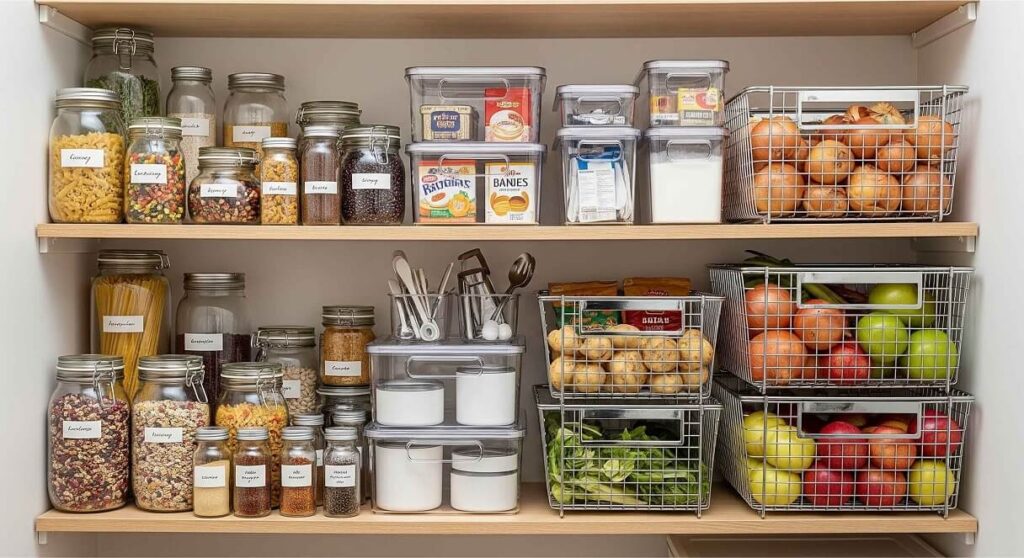
Switching from original packaging to clear, airtight containers is one of those changes that feels slightly fussy until you actually do it, and then you can’t imagine going back.
The visual clarity alone is worth it. You can see at a glance whether you’re low on rice, how much flour is left, or when you’re running low on granola.
Beyond the aesthetics, there are real practical gains. For example, clear containers stack neatly, which means you can use vertical space more efficiently. They’re also uniform in shape, so they don’t create the unsightly mess of awkward boxes and half-open bags all competing for shelf space.
And because dry goods stay sealed properly, they last longer, which ties directly back to reducing the food waste we talked about at the start.
Embrace labels as they are the natural companion to clear containers. Even when you can see what’s inside, a label that includes the item name (and if you’re really organized, a restock date) is an added advantage. It means anyone in the household can maintain the system, not just the person who set it up.
Lazy Susans, The Unsung Hero of Deep Shelves

There are few things more frustrating than a deep pantry shelf. Everything looks organized from the front, but if you need something from the back, you’re practically climbing inside to reach it.
This results in things getting pushed to the rear, forgotten, and eventually expiring.
A Lazy Susan solves this beautifully. These rotating turntables let you spin a shelf around so that everything, including items at the back, comes to you.
They’re particularly brilliant for oils, condiments, vinegars, and sauces- things that come in tall, awkward bottles that are hard to stack or group neatly any other way.
For corner shelves or deep cabinets, a two-tier Lazy Susan doubles the capacity. Some even have center pull-out sections, which means even more access.
It’s a small investment that erases one of the most common pantry frustrations.
Pull-Out Drawers for the Bottom Shelves
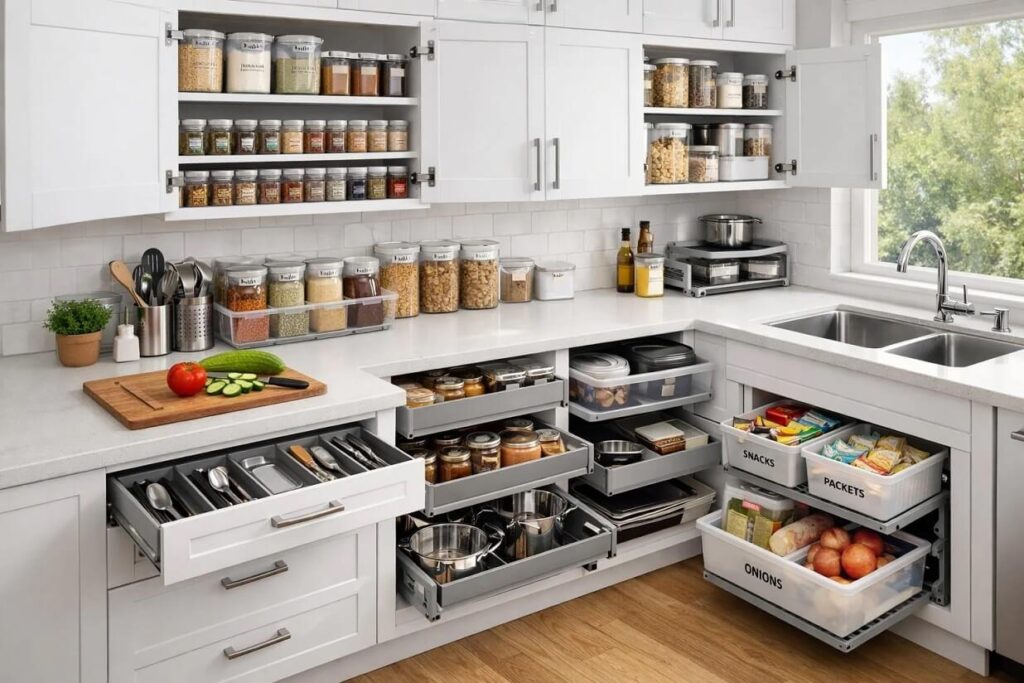
The lower shelves of a pantry are a notoriously tricky zone. They’re hard to see into and even harder to reach into, so most people end up storing things there and promptly forgetting about them. It’s prime storage space that effectively becomes dead space.
But with pull-out drawers, you bring the contents of the shelf to you instead of crouching down and digging around.
Moreover, they’re easier to install, and you can use them for bulkier items like canned goods, root vegetables, or those oversized bags of rice and flour that don’t fit neatly anywhere else.
Make Use of Baskets and Bins
Baskets and bins are the simplest and most effective pantry tools, mostly overlooked. Grouping items into labeled bins creates “zones,” and makes a pantry easy to navigate for everyone in the household, not just the person who organized it.
Think of it like a well-designed grocery store, whereby you don’t have to read every label to know roughly where to find things because the layout makes sense. When your pantry operates on that same logic, restocking and meal planning become almost effortless.
Woven baskets are aesthetically appealing and are great for snacks or produce. On the other hand, wire bins are better for visibility and heavier items, whereas clear acrylic or plastic bins work well when you want a clean, modern look.
The material matters less than the consistency, as mixing a dozen different container styles creates visual noise, even when everything is technically organized.
Spice Storage Deserves Its Own Moment
Storing spices can sometimes feel chaotic since they come in inconsistent sizes and are small enough to get lost behind larger items. This results in most people having at least twice as many as they often use.
Getting spice storage right therefore makes a disproportionate difference to how the whole pantry feels.
Consider using a dedicated spice rack or a pull-out spice drawer to keep your spices contained and visible. If you’re using shelf space, a tiered spice riser ensures you can see every label without pulling half the shelf apart.
Some people go the extra step of decanting spices into uniform jars with labels on the lid, so when they’re stored face-up in a drawer, you can read them all at once.
The most important thing is keeping them in one place. When spices are scattered across three different shelves mixed in with other items, cooking becomes an exercise in treasure hunting. A single, dedicated spice zone, even a small one, changes that entirely.
Function Comes First, Aesthetics Second, but Both Can Win

If you scroll through the internet, you’ll most likely find a lot of information dedicated to pantry goals, from immaculately organized spaces with matching containers with perfect labels, and a calm that feels almost spiritual.
And while I’m not suggesting you need to achieve that level of perfection, it’s worth knowing that a good-looking pantry isn’t a matter of vanity.
Research and design experts have long noted that the visual organization of a space affects how we interact with it. When a pantry is visually calm, we’re more likely to maintain it, see what we have, and less likely to abandon the system after a week.
I bet you are wondering how to get there without spending a fortune. Well, be consistent by, for example, picking two or three container types and sticking to them. Additionally, choose a single label style and keep the color palette simple.
The secret is not to buy everything at once and to maintain consistency.
The Maintenance Habit Nobody Talks About
Here’s the thing about pantry storage and organization: the setup is only half the work. The system you create only stays useful if you do a quick reset now and then.
Most professional organizers recommend a light pantry audit every few months, just a pass-through to check expiry dates, notice what’s running low, and make sure things haven’t migrated back to chaos.
This may take you a few minutes or an hour tops not the kind of thing you need to schedule a whole afternoon for. But without it, pantries creep back toward their original state.
The best organizational systems are those that are easy enough to maintain. That’s worth keeping in mind as you make decisions about containers, labels, and zones.
The goal isn’t a perfect pantry but one that works on an ordinary day when you’re tired and trying to figure out what to cook.
Conclusion
A well-organized pantry is one of those home improvements that sound boring right up until the moment it changes your daily life.
With the pantry storage ideas discussed above, you can make the ordinary things easier, i.e., cooking, shopping, staying on top of what you have, and wasting less.
Always remember that the most powerful thing about a good pantry storage system is clarity. When you can see everything you have, you make better decisions, spend less money, and feel more in control of your home.
That’s the real payoff, and it’s available to every pantry, no matter how small or humble.