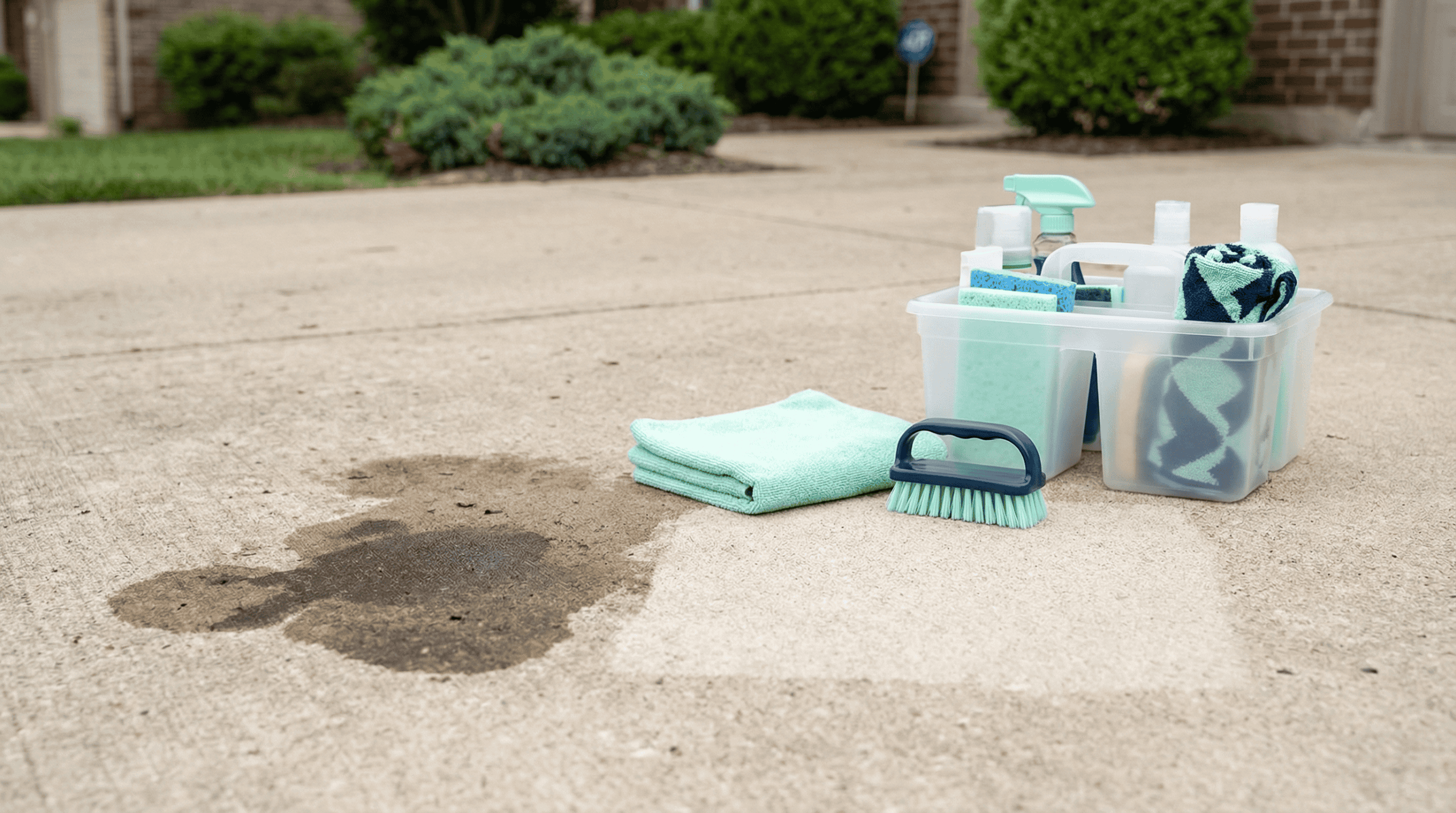
A clean driveway makes an entire home look better, yet a single dark grease stain can undo that quite quickly. Oil drips beneath a parked car, lawn-mower splashes, and spills from a weekend repair project can leave ugly marks that seem to become part of the concrete.
The frustrating part is that concrete looks solid and impermeable, but it behaves more like a hard sponge. That’s why a quick rinse with a garden hose often does little, especially on old stains.
Fortunately, with the right cleaning method, most grease stains can be improved significantly. Fresh spills, for instance, need simple household supplies, while older, darker patches require a little more patience.
Today’s article is about How to Remove Grease Stains from Concrete Surfaces and Driveways, and I’ll walk you through practical ways of doing this, from dealing with a fresh spill to tackling stubborn marks that resist ordinary scrubbing.
You’ll also learn what to avoid, how to protect nearby plants, and how to avoid grease stains in the future.
7 Methods on How to Remove Grease Stains from Concrete Surfaces and Driveways
Method 1: Remove Fresh Grease Stains Before They Set
Clear any small oil puddle beneath your car, or cooking oil that has dripped onto the concrete in the kitchen to prevent it from becoming a permanent mark.
Step 1: Blot up the excess grease
If there’s liquid oil on the surface, gently blot it with paper towels or an absorbent cloth by lifting the material straight up instead of rubbing it across the concrete, as it can spread the oil over a wider area.
For a larger spill, skip the paper towels and reach for an absorbent product to remove as much free oil as possible before introducing water or detergent.
Step 2: Cover the stain with an absorbent
To cover the stain, sprinkle a generous layer of oil absorbent over the affected area. Press it down gently with a gloved hand or the back of a scoop, but don’t grind it into the concrete.
Leave it in place for several hours, or overnight if the spill is substantial and the product instructions allow it. This helps with drawing up excess oil, making the next step much easier.
Step 3: Collect the used absorbent
Do this by sweeping or scraping the oil-soaked material into a dustpan. Then place it in a suitable container and follow local waste disposal guidance, particularly if it contains automotive oil or other hazardous residues.
Don’t hose the granules into the garden or street. That transfers the problem from your driveway to somewhere else.
Step 4: Wash with dish soap
Apply a small amount of grease-cutting dishwashing liquid to the remaining mark. Add a little warm water, then scrub with a stiff nylon brush using overlapping circular movements.
Give the detergent a few minutes to work, provided the product directions allow it. Rinse it off and allow the concrete to dry before deciding whether the stain has disappeared.
Method 2: Use Baking Soda for Small, Light Grease Marks
This is a convenient option for minor grease marks, especially when you don’t have a specialist cleaner available. Its fine particles provide mild abrasion, while the paste helps keep the cleaning mixture in contact with the stain.
It is more suitable for light surface grease than for thick motor oil that has soaked deep into an unsealed driveway.
How to use it
First, remove any loose oil with paper towels or an absorbent material. Then sprinkle baking soda over the stain and add a small amount of water to form a thick paste.
Work the paste gently into the concrete with a nylon brush and allow it to sit for about 15 to 30 minutes, then scrub again and collect the residue before rinsing.
If the stain is particularly greasy, add a small amount of dishwashing liquid to help loosen the remaining residue.
Method 3: Clean Stubborn Stains with Dishwashing Liquid or Laundry Detergent
If a stain is too stubborn, use a concentrated grease-cutting dishwashing liquid. It contains surfactants that loosen the grease and disperse it into water during cleaning.
Start by removing any remaining surface oil with an absorbent material. Then apply a generous amount of detergent to the stain, following the product’s dilution instructions.
After that, add a little warm water and scrub with a stiff nylon brush, paying attention to the edges of the mark.
Next, lift the dirty solution with absorbent cloths, rinse, and leave the concrete to dry.
For a broad stain, use a push broom with stiff nylon bristles to cover the entire area easily and evenly.
Method 4: Apply a Concrete Degreaser for Deep or Old Grease Stains
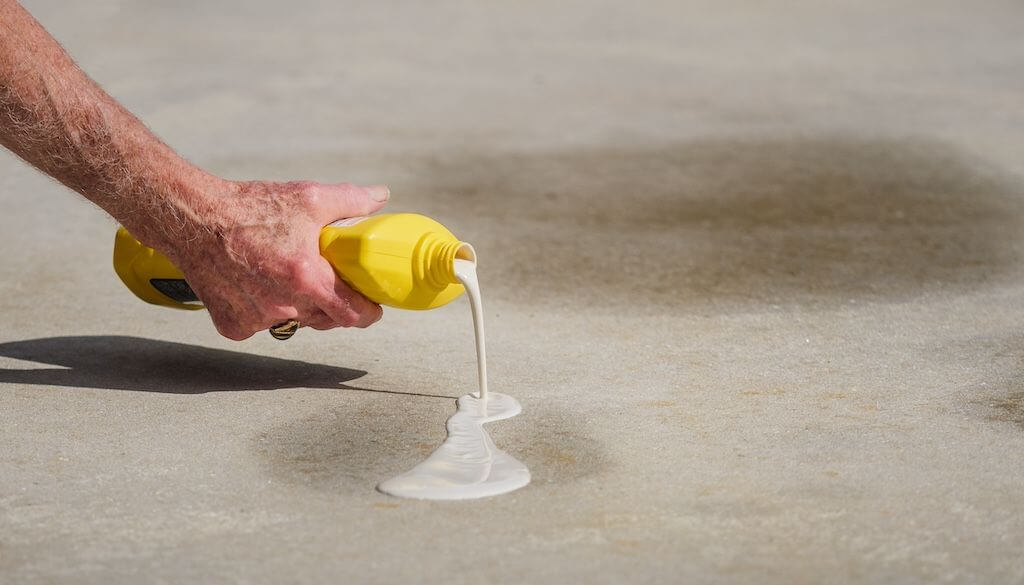
Concrete is porous, so grease soaks in and settles below the surface. A good degreaser breaks that oil down and lifts it back out. For old stains, choose the right product, plenty of dwell time, and repeat the process whenever needed.
Types of degreaser to choose from
- Alkaline (caustic) degreasers: These are strong, fast-acting, and the usual choice for heavy, old stains.
- Solvent-based degreasers: They dissolve thick, gummy, or petroleum-heavy buildup, but they have stronger fumes and are more flammable.
- Enzyme or bio-based degreasers: These are gentler and eco-friendly but work slowly.
- Powdered or gel degreasers: They cling to the surface longer than thin liquids, which helps with old stains.
Steps
- Clear and soak up surface oilandcover fresh or tacky oil with cat litter or sawdust; let it absorb, then sweep it up.
- Wet the concrete lightly with water.
- Apply the degreaser and leave it for about 15 to 30 minutes or as directed, then scrub.
- Rinse thoroughly and allow the surface to dry.
Method 5: Use Poultice to Remove Grease Stains from Concrete Surfaces and Driveways
There are two ways to make a poultice to remove stains from concrete surfaces and driveways.
First, for a straightforward approach, choose a commercial oil stain poultice formulated for concrete. Follow the mixing and application, drying time, and removal instructions.
This is the safest way to ensure the ingredients are compatible and the product is the right one for your surface.
Second, if you’re using a homemade mixture, the ingredients must be appropriate for concrete and for that specific grease.
Once the mixture is ready, soak up any surface oil with dry cat litter or sawdust, then sweep it away. Then scrub with degreaser and hot water, rinse, and let the concrete dry.
Next, mix the paste by adding solvent to the powder a little at a time until it’s a smooth and velvety consistency for easy spreading. Spread the paste about ¼ to ½ inch thick over the stain, extending a few inches beyond the edges.
After that, lay plastic wrap over the paste and tape the edges to slow the evaporation rate and give the solvent time to dissolve the oil. This should take approximately 24 hours.
Finally, remove the plastic and let the paste dry completely, usually 24 to 48 hours, to pull the oil up into the powder; then, scrape off the dried paste with a plastic scraper, sweep up the residue, and follow this with scrubbing with detergent and rinsing.
Method 6: Pressure Washer to Remove Grease Stains from Concrete Surfaces
Pressure washing works best on grease when it’s paired with a degreaser, because water pressure alone tends to push surface grease around rather than lift it out of the pores.
Start by gathering your gear i.e. a pressure washer rated about 2,500-3,500 PSI (a rating around 3,000 PSI is ideal for concrete). The nozzle can be 15° or 25° for general work, or you can get a surface cleaner attachment if the area is large and flat.
Other items are concrete degreaser, stiff nylon brush, absorbent material, safety glasses and gloves
Next, prepare the area by clearing the surface of debris. Then, blot up any fresh grease with cat litter or an absorbent powder, let it sit a few hours, sweep it away and pre-wet the concrete lightly with plain water.
After that, pre-treat with degreaser by applying a concrete degreaser generously over the stain and a few inches past its edges. Scrub it in with a stiff brush, then let it settle for 15-30 minutes (or per the label). Don’t let it dry out; mist it if needed.
The surface is now ready for pressure washing. Do this by holding the nozzle at a slight angle about 6-12 inches from the surface.
Tip: Use a sweeping, overlapping motion, working from the cleanest areas toward the stain, and keep the wand moving. Avoid using a zero-degree (red) nozzle because it can etch the concrete and leave permanent tracks.
Lastly, rinse the area thoroughly and let the concrete dry.
Method 7: Try an Enzyme-Based Cleaner for Persistent Oil Residues
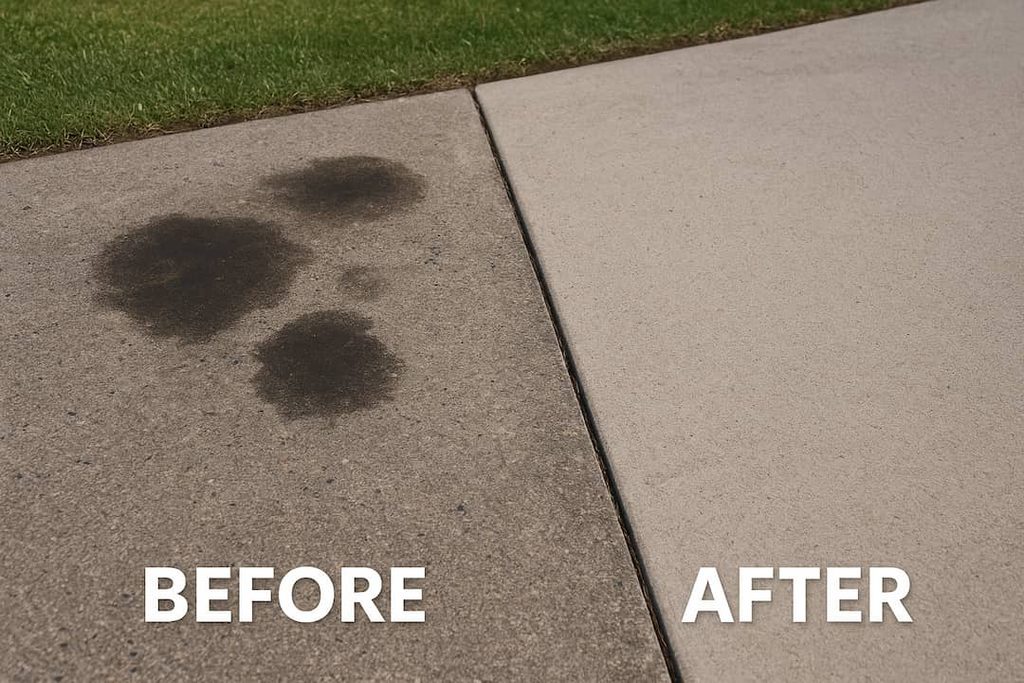
Enzyme-based cleaners work by biologically breaking down oil into smaller, water-soluble compounds, so the process rewards patience more than scrubbing force.
First, soak up any fresh pooled oil with cat litter, sawdust, or an absorbent powder. Let it sit for a few hours, then sweep it up. Follow this by dampening the concrete with water to give the enzymes enough moisture to remain active, and to dampen the pore structure for the product to soak in.
Second, pour or spray the cleaner generously over the stain, extending a few inches beyond the edges to catch oil that has wicked outward. Then, work it in with a stiff brush so it reaches into the concrete’s pores.
Third, keep the area moist by covering it with plastic sheeting or a damp tarp, or by re-misting as it dries.
Fourth, scrub again with a stiff brush, then rinse with clean water.
Finally, collect or direct runoff appropriately, since you’re rinsing oil residue away.
Conclusion
The biggest difference in how easy or difficult it is to Remove Grease Stains from Concrete Surfaces and Driveways often comes down to timing.
Fresh grease gives you a chance to absorb most of the problem before it settles into the concrete. Older stains require more patience because the oil has had time to work its way into the surface.
Start by removing excess grease, choose a suitable concrete cleaner, and give it enough time to work. If the stain remains, try a dedicated degreaser and then, if necessary, a suitable poultice.
Above all, don’t confuse effort with effectiveness. A drip mat, a repaired leak, or a suitable concrete sealer can help prevent the same dark patch from returning. After all, the easiest driveway stain to remove is the one that never gets the chance to settle in.
Read: A Step-by-Step Guide on Sealing Concrete Floor
Featured Image Credit: Upstairs Downstairs Cleaning Services